API Reference
The TraceAgent server exposes an HTTP API. This page lists the endpoints and details the ones used to send data and to follow a run live. The examples use the default address http://127.0.0.1:8000.
Endpoints
| Method | Path | What it does |
|---|---|---|
POST | /api/runs | Create a run (agent name, goal, optional metadata) |
GET | /api/runs | List runs, newest first |
GET | /api/runs/{id} | One run: status, counters, provider, model, token usage, flags |
POST | /api/runs/{id}/tool-results | Record tool executions (also counts tools and errors) |
POST | /api/runs/{id}/observations | Record other events: model calls, commands, file changes, framework events |
POST | /api/runs/{id}/finish | Mark the run as completed with its final output |
POST | /api/runs/{id}/fail | Mark the run as failed with an error code and message |
GET | /api/runs/{id}/events | Raw events of the run, in order |
GET | /api/runs/{id}/events/stream | Live events as Server-Sent Events |
GET | /api/runs/{id}/timeline | Events grouped by step (agent run, model call, tool), with durations |
GET | /api/runs/{id}/graph?view=execution|decisions | Nodes and edges ready for a graph viewer |
GET | /api/runs/{id}/explanation | Plain-language narrative, the decisions taken and flags such as retries or loops |
GET | /api/runs/{id}/analytics | Tool metrics, tool graph and similar runs |
GET | /api/runs/compare?left_run_id=…&right_run_id=… | Difference between two runs, with the likely root cause |
GET | /api/dashboard?period=24h|7d|30d | Totals, trends, top tools and top errors |
POST | /v1/traces | OpenTelemetry receiver (OTLP/HTTP, protobuf or JSON, gzip). Root path, not under /api |
GET | /health | Health check |
Run States
A run is in one of these states: running, completed or failed. A finished run is completed (not "finished").
Decisions (tool choice, retry, recovery) and flags are derived when a run ends or fails, not while it runs. A running run shows none yet.
POST /v1/traces
OTLP/HTTP receiver for OpenTelemetry traces. See OpenTelemetry Ingestion for how to set it up.
Content types: application/x-protobuf (what exporters send by default) and application/json. Content-Encoding: gzip and deflate are accepted.
Response: 200 OK with an empty ExportTraceServiceResponse ({} in JSON). If some spans could not be understood, a protobuf response reports them in partial_success.rejected_spans.
Example (JSON)
POST /v1/traces
Content-Type: application/json
{
  "resourceSpans": [{
    "resource": {"attributes": [{"key": "service.name", "value": {"stringValue": "weather-service"}}]},
    "scopeSpans": [{
      "scope": {"name": "pydantic-ai"},
      "spans": [
        {"traceId": "5b8efff798038103d269b633813fc60c", "spanId": "eee19b7ec3c1b174", "name": "invoke_agent weather",
         "startTimeUnixNano": "1792764785544708352", "endTimeUnixNano": "1792764788544708352",
         "attributes": [
           {"key": "gen_ai.operation.name", "value": {"stringValue": "invoke_agent"}},
           {"key": "gen_ai.agent.name", "value": {"stringValue": "weather"}},
           {"key": "gen_ai.agent.call.id", "value": {"stringValue": "call-1"}},
           {"key": "final_result", "value": {"stringValue": "It is sunny in Madrid."}}]},
        {"traceId": "5b8efff798038103d269b633813fc60c", "spanId": "eee19b7ec3c1b175", "parentSpanId": "eee19b7ec3c1b174",
         "name": "chat gpt-4o", "startTimeUnixNano": "1792764785644708352", "endTimeUnixNano": "1792764787044708352",
         "attributes": [
           {"key": "gen_ai.operation.name", "value": {"stringValue": "chat"}},
           {"key": "gen_ai.provider.name", "value": {"stringValue": "openai"}},
           {"key": "gen_ai.request.model", "value": {"stringValue": "gpt-4o"}},
           {"key": "gen_ai.usage.input_tokens", "value": {"intValue": "120"}},
           {"key": "gen_ai.usage.output_tokens", "value": {"intValue": "24"}},
           {"key": "gen_ai.agent.call.id", "value": {"stringValue": "call-1"}}]}
      ]
    }]
  }]
}
The server creates the run 5b8efff7-9803-8103-d269-b633813fc60c (the trace id written as a UUID) with agent weather, status completed, provider openai, model gpt-4o, 120 prompt tokens and 24 completion tokens.
In OTLP/JSON, ids are hexadecimal strings and 64-bit integers are strings ("intValue": "120").
Errors
| Case | Response |
|---|---|
| Body that is not OTLP | 400 {"detail":"Invalid OTLP protobuf body: ..."} |
| Unsupported content type | 400 {"detail":"Unsupported Content-Type 'text/plain'."} |
Corrupt gzip or unknown Content-Encoding | 400 {"detail":"Invalid gzip body: ..."} / {"detail":"Unsupported Content-Encoding 'br'."} |
Body over TRACE_AGENT_OTLP_MAX_BODY_BYTES | 413 |
Receiver turned off (TRACE_AGENT_OTLP_ENABLED=false) | 404 {"detail":"The OTLP receiver is disabled."} |
Span attributes read
Only spans whose gen_ai.operation.name is invoke_agent, chat or execute_tool are used. The span id becomes the step id, the parent span id becomes the parent step, and times and durations come from the span start and end. A span status of UNSET or OK is a success; only ERROR is a failure, with the exception class name as error code and the exception message as error message.
invoke_agent → chain.started, chain.completed / chain.failed
| Attribute | Used for |
|---|---|
gen_ai.agent.name | Agent name. Names the run when it is created |
gen_ai.agent.call.id | Identifies the agent call. The run ends when no call is left open |
gen_ai.conversation.id | Stored in the event metadata |
gen_ai.aggregated_usage.input_tokens / output_tokens | Event metadata |
final_result | Final output of the run (summarized) |
chat → llm.started, llm.completed / llm.failed
| Attribute | Used for |
|---|---|
gen_ai.provider.name (fallback gen_ai.system) | Provider of the event and of the run |
gen_ai.response.model (preferred) / gen_ai.request.model | Model of the event and of the run |
gen_ai.usage.input_tokens / gen_ai.usage.output_tokens | Prompt and completion tokens, added to the run totals |
gen_ai.response.finish_reasons | Event metadata |
gen_ai.input.messages | Goal of the run (first user text, when the run is created) |
gen_ai.output.messages | Names of the requested tools |
execute_tool → tool.started, tool.succeeded / tool.failed
| Attribute | Used for |
|---|---|
gen_ai.tool.name | Tool name |
gen_ai.tool.call.id | Call id |
gen_ai.tool.call.arguments | Arguments (long values are truncated) |
gen_ai.tool.call.result | Output summary |
Attributes that configure TraceAgent
| Attribute | Used for |
|---|---|
service.name (resource) | Fallback agent name |
trace_agent.run_id (resource, or on every span) | Attach the spans to an existing run |
POST /api/runs/{id}/tool-results
Reports tool executions of a run. Each result records both tool.started and tool.succeeded / tool.failed, and updates the run's counters.
{
  "results": [{
    "call_id": "c1",
    "name": "weather",
    "step_id": "tool-1",
    "parent_step_id": "llm-1",
    "status": "succeeded",
    "args": {"city": "Madrid"},
    "output_summary": "Sunny",
    "duration_ms": 12
  }]
}
parent_step_id is optional. It hangs the tool from its parent step in the timeline.
Report a tool through this endpoint or through a tool_call observation, never both. Doing both duplicates the events and counts errors twice.
GET /api/runs/{id}/events/stream
Server-Sent Events stream to follow a run live. The response is 200 with content-type: text/event-stream.
data: {"type": "connected", "run_id": "ad76681d-6a6a-4666-be32-377ae8544420"}

data: {"id": 29, "seq": 3, "type": "tool.started", "actor": "sdk", "summary": "Started weather.", "status": "running", "step_id": "tool-1", "tool_name": "weather", "timestamp": "2026-10-23T14:13:12.435113+00:00"}

data: {"id": 30, "seq": 4, "type": "tool.succeeded", "actor": "sdk", "summary": "Sunny", "status": "succeeded", "step_id": "tool-1", "tool_name": "weather", "timestamp": "2026-10-23T14:13:12.439109+00:00"}

data: {"id": 31, "seq": 5, "type": "run.completed", "actor": "proxy", "summary": "It is sunny in Madrid.", "status": "completed", "step_id": null, "tool_name": null, "timestamp": "2026-10-23T14:13:12.487165+00:00"}
- The first message is
{"type": "connected"}. - A
{"type": "heartbeat"}message is sent after every 15 seconds without events. - Every other message is one recorded event, and its
typeis the event type itself (tool.succeeded,run.completed...).
GET /api/runs/{id}/timeline
Returns the events of a run grouped by step. This is what the UI timeline is built from.
{
  "run_id": "ce67fce7-8cbe-4df8-b3c0-deef2070afad",
  "groups": [
    {
      "step_id": "run-08b5ddf944d3",
      "label": "chain.completed",
      "status": "succeeded",
      "parent_step_id": null,
      "event_count": 2,
      "duration_ms": 21,
      "events": [
        { "seq": 2,  "type": "chain.started",   "summary": "Pydantic AI run 'support-agent' started",   "status": "running" },
        { "seq": 13, "type": "chain.completed", "summary": "Pydantic AI run 'support-agent' completed", "status": "succeeded", "duration_ms": 21 }
      ]
    },
    {
      "step_id": "tool-a61c92ca8864",
      "label": "lookup_order",
      "status": "failed",
      "tool_name": "lookup_order",
      "parent_step_id": "run-08b5ddf944d3",
      "event_count": 2,
      "duration_ms": 0,
      "events": [
        { "seq": 5, "type": "tool.started", "summary": "Started lookup_order." },
        { "seq": 6, "type": "tool.failed",  "summary": "The orders service timed out, try again", "status": "failed" }
      ]
    }
  ]
}
parent_step_id is what nests each step under its parent: model calls and tools hang from the agent step. Single events such as run.started and run.completed have no parent.
The UI shows readable names ("Agent run", "Model call"). In the API, label stays the technical event type (chain.completed, llm.completed) or the tool name.
GET /api/runs/compare
Compares two runs: GET /api/runs/compare?left_run_id=<id>&right_run_id=<id>. The UI shows the same data in its Compare view, here with the token and duration difference between two runs:
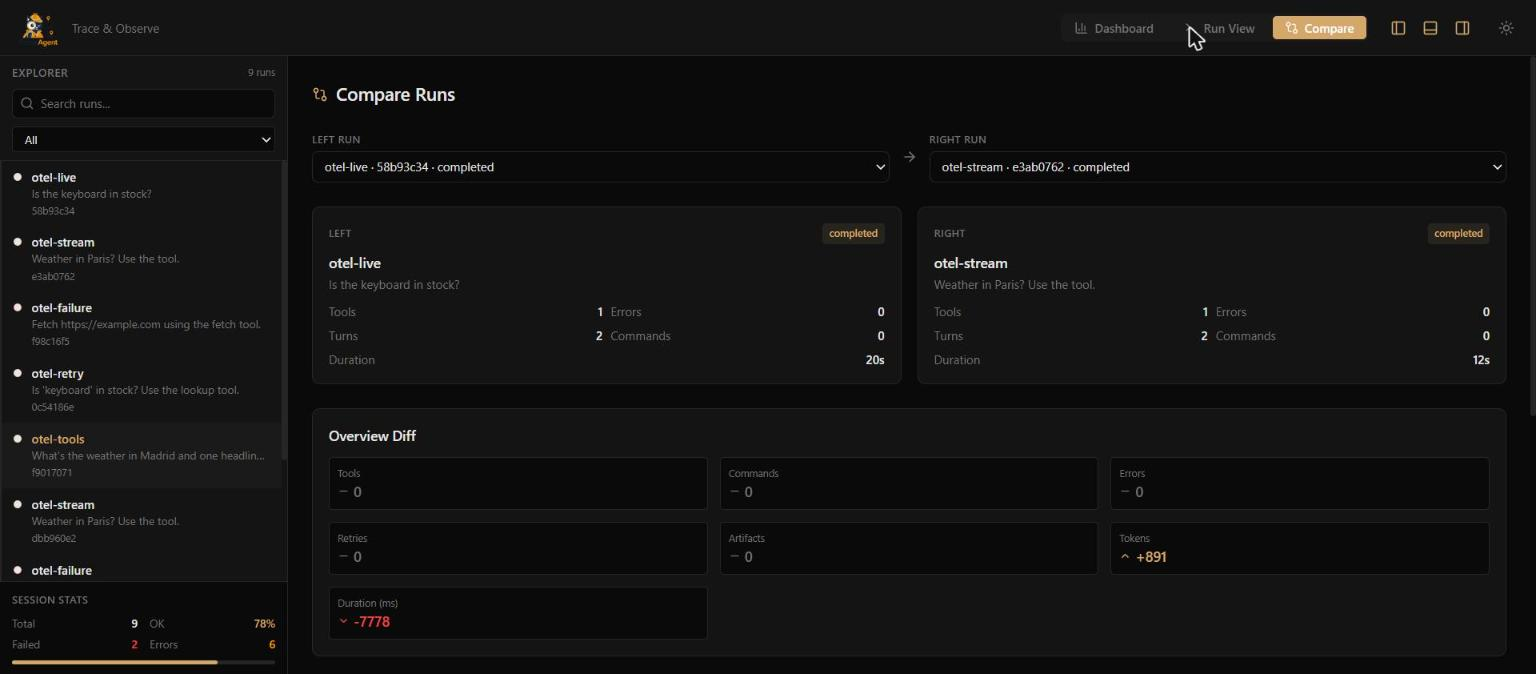
The response has these top-level keys:
| Key | Content |
|---|---|
left_run, right_run | The overview of each run, in the same format as GET /api/runs/{id} |
overview_diff | Differences between the two runs as signed numbers (right minus left): tool, command, error, retry and artifact counts, total tokens and duration in milliseconds. A positive number means the right run has more. duration_ms_delta is null if either run has not finished |
divergence | The first point where the two runs stop doing the same thing: the kind of step that differs, the event ids on each side and a one-line summary. It is null when the runs never diverge |
aligned_timeline | The steps of both runs paired up in order (see the pair format below) |
tool_diff, command_diff, file_diff, artifact_diff, decision_diff | The same pair format, limited to tools, commands, file changes, artifacts or decisions |
root_cause | The most likely reason the runs differ: a label, a summary, the first event on each side that caused the difference, the events that support it (supporting_event_ids), the impact and a confidence of high, medium or low. If the runs don't diverge, the label is no_observable_root_cause |
evidence | The full events of both runs, keyed by event id under left and right, so every event id mentioned above can be looked up |
Each pair in aligned_timeline and in the *_diff lists has a relation (shared, left_only, right_only or different), a kind, a summary, and a left and right side. Each side has its label, status, summary, event_ids, step_id, duration_ms and metadata.